You hit a certain age and the meals that kept you energized for decades suddenly stop working. The scale shifts, sleep fractures, and your joints ache. This is not a failure of willpower. During menopause, persistently low estrogen levels can contribute to inflammation and metabolic shifts that change how your body processes food.
When I was working to reverse my own prediabetes and heal my metabolism, I learned quickly that you cannot starve your way out of a hormonal imbalance. Counting calories while ignoring inflammation is a losing game. Created by an OB-GYN, the Galveston Diet steps directly into that reality. It is a protocol designed specifically to cool the metabolic fire of menopause.
It skips standard restriction and focuses entirely on changing what your body uses for fuel. Understanding the theory is easy, but putting it on a plate requires a clear plan.
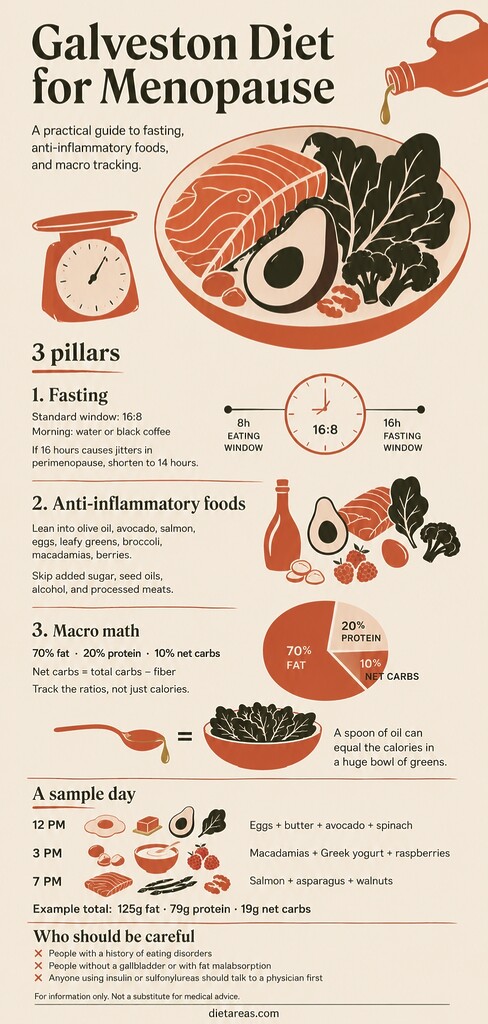
The 3 Pillars of the Protocol
While starting with just one habit is a great first step, these three pillars are designed to work together. The fasting creates the environment, the food quality reduces the inflammation, and the macro ratio trains your body to burn fat. Bringing them together is where you see the biggest shift.
1. Intermittent Fasting (16:8)
The standard protocol asks you to fast for 16 hours and eat all your meals within an 8-hour window. For most, this means drinking only black coffee or water in the morning, eating your first meal at noon, and finishing dinner by 8:00 PM. A 16:8 window may lower insulin levels and improve glucose handling, but the cellular-cleanup piece is more complex than one guaranteed timer.
There is an important distinction between menopause and perimenopause here. If you are fully in menopause, a 16-hour fast may help some women manage insulin response within a structured routine. However, if you are still in perimenopause, your hormones are violently fluctuating rather than staying low. For some women, a strict 16-hour fast during perimenopause spikes cortisol and causes severe jitters. If that happens, do not force it. Drop your window to 14 hours to allow your metabolism to rest without adding stress.
2. Anti-Inflammatory Ingredients
This is not a free pass to eat processed foods just because they fit a fasting window. The diet targets ingredients the plan frames as drivers of joint pain, brain fog, and insulin spikes. The rules are specific because they are built around blood-sugar response and food quality.
Eat freely: Extra virgin olive oil, avocados, macadamia nuts, wild-caught salmon, grass-fed beef, dark leafy greens, and cruciferous vegetables like broccoli.
The fruit rule: Berries are the primary recommended fruit. They are packed with antioxidants but have a much lower glycemic impact than bananas or grapes, keeping your blood sugar steady.
The grain and legume rule: You are not excluding beans and quinoa because they are unhealthy. You limit them because hitting a strict 10 percent carbohydrate limit is mathematically impossible if you eat a bowl of lentils.
Eliminate completely: Added sugars, vegetable oils like canola and soybean, alcohol, and processed meats.
3. Macro Tracking and Net Carbs
The core of the Galveston Diet is a daily macronutrient breakdown: 70 percent fat, 20 percent protein, and 10 percent net carbohydrates.
Before doing the math, you need to understand net carbs. Net carbs simply mean total carbohydrates minus dietary fiber. Because your body cannot digest fiber into glucose, it does not spike your blood sugar the way digestible carbs do. You do not count fiber against your daily 10 percent limit. This is exactly how you can eat massive bowls of leafy greens while staying strictly low-carb.
This macro ratio also creates a massive point of confusion regarding calories versus volume. These percentages apply to your calories, not the physical volume of food on your plate. Fat is incredibly dense. It contains 9 calories per gram, while protein and carbs only contain 4. A single tablespoon of olive oil carries the same calories as a massive mixing bowl full of raw spinach.
How to set your personal targets:
Find your baseline: Use a free online calculator to find how many calories you need to maintain your weight. Subtract about 300 calories for a gentle deficit. Let us assume your target is 1,500 calories.
Calculate your fat: 70 percent of 1,500 is 1,050 calories. Divide that by 9. Your daily goal is roughly 117 grams of fat.
Calculate your protein: 20 percent of 1,500 is 300 calories. Divide by 4. Your goal is 75 grams of protein.
Calculate your carbs: 10 percent of 1,500 is 150 calories. Divide by 4. Your goal is roughly 37 grams of net carbs.
You do not count calories to restrict them blindly. You track them to ensure your macro percentages are actually correct.
What a Calculated Day Actually Looks Like
To show how this math works in the kitchen, here is a sample day built around our 1,500-calorie example target (117g fat, 75g protein, 37g net carbs as the upper limit). Notice how the heavy fats are woven seamlessly into satisfying portions.
Meal 1: The Fast-Breaker (12:00 PM)
Three large eggs cooked in 1 tablespoon of butter, half of a medium avocado, and 2 cups of fresh spinach tossed in 1 tablespoon of extra virgin olive oil. The math: roughly 51g fat, 22g protein, 3g net carbs.
Snack (3:00 PM)
One ounce of macadamia nuts, a half-cup of full-fat plain Greek yogurt, and a half-cup of fresh raspberries. The math: roughly 27g fat, 13g protein, 9g net carbs.
Meal 2: Dinner (7:00 PM)
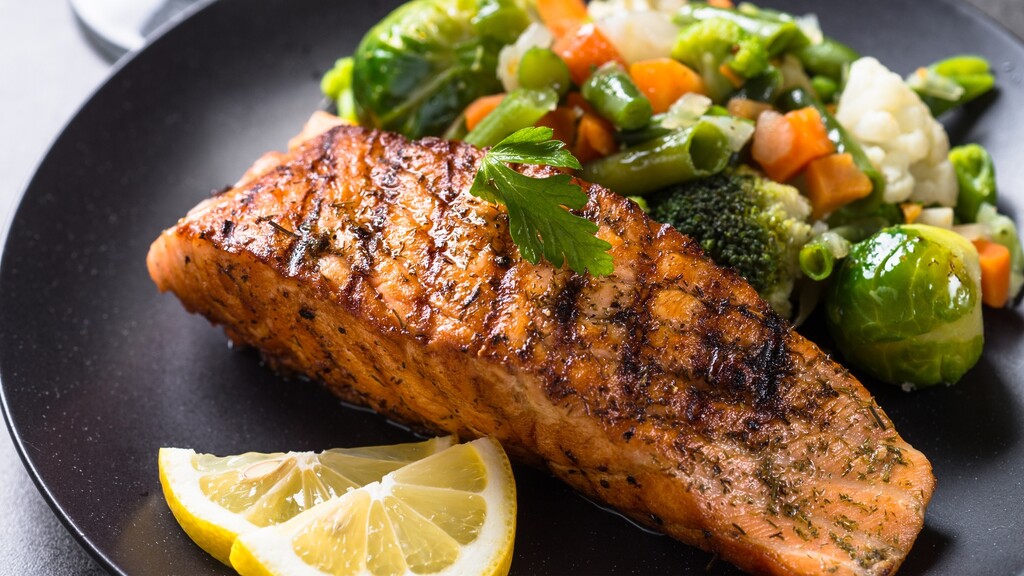
Six ounces of wild-caught salmon pan-seared in 1 tablespoon of ghee, served alongside 1.5 cups of asparagus roasted in olive oil, garnished with 1 tablespoon of crushed walnuts. The math: roughly 47g fat, 44g protein, 7g net carbs.
Daily Total: roughly 125g Fat, 79g Protein, 19g Net Carbs. Depending on exact brands and portions, this comes in near the 1,500-calorie target and stays well under the 37g net-carb ceiling, proving you can stay strictly low-carb without eating tiny portions.
Who Should Skip This Protocol
A high-fat, fasting-based protocol is not universally safe. If you have a history of eating disorders, the strict macro tracking and fasting windows can easily trigger old habits.
If you have had your gallbladder removed or struggle with fat malabsorption, a diet demanding 70 percent fat can cause digestive distress. Finally, anyone managing type 2 diabetes with insulin or sulfonylureas must consult a physician before attempting a 16-hour fast to avoid dangerous hypoglycemic episodes.
Real-Life Troubleshooting
You will not execute this perfectly every day. Knowing how to handle the friction is what keeps you on the plan.
What if I eat outside my fasting window?
If you wake up starving and eat breakfast at 9:00 AM, the day is not ruined. You simply broke your fast early. Do not punish yourself by skipping lunch or restricting calories later. Eat your anti-inflammatory meals as planned, focus on your macros, and restart your normal 16-hour clock after dinner.
How do I eat at a restaurant?r
Dining out on a 10 percent carbohydrate limit is difficult because restaurants cook with hidden sugars and seed oils, though studies on linoleic acid have not shown that these oils automatically drive inflammation. Your safest option is ordering a grilled protein like steak or salmon and asking for a side of vegetables steamed or cooked in butter. Ask for olive oil and lemon wedges to dress your own salad.
Should I change my macros on workout days?
For standard Pilates, yoga, or light walking, keep your macros exactly the same. If you are doing heavy weightlifting, you may need to increase your protein slightly for muscle repair, but do not flood your system with carbohydrates. Your body is adapting to burn fat for fuel.
You now have the full picture. You understand how to calculate your personal macros instead of guessing, how to subtract fiber to find your net carbs, and why healthy fats must make up the mathematical majority of your calories rather than the physical volume of your plate. You also know that perimenopause and menopause require slightly different fasting windows. The Galveston Diet is not a magical cure, but it is a highly logical response to what your hormones are actually doing. Get your kitchen scale, trust the math, and give your metabolism the specific fuel it needs right now.




 This post may contain affiliate links.