You logged the grilled chicken. You weighed the almonds. You hit your target for a solid month. Yet when you stepped on the scale today, the number had not moved an inch. If you are not losing weight in a calorie deficit, the math is not always the whole problem. Your body may be adapting.
We are taught a very rigid equation for weight management. Eat less energy than you burn, and the pounds will drop. The logic seems bulletproof on paper.
But human biology does not read textbooks. During my early years handling my own PCOS diagnosis, I ate roughly 1,200 calories a day and somehow gained two pounds in a month. I felt entirely betrayed by my own metabolism. I assumed I was simply failing at the math. The reality was that my hormones were actively fighting my food tracker.
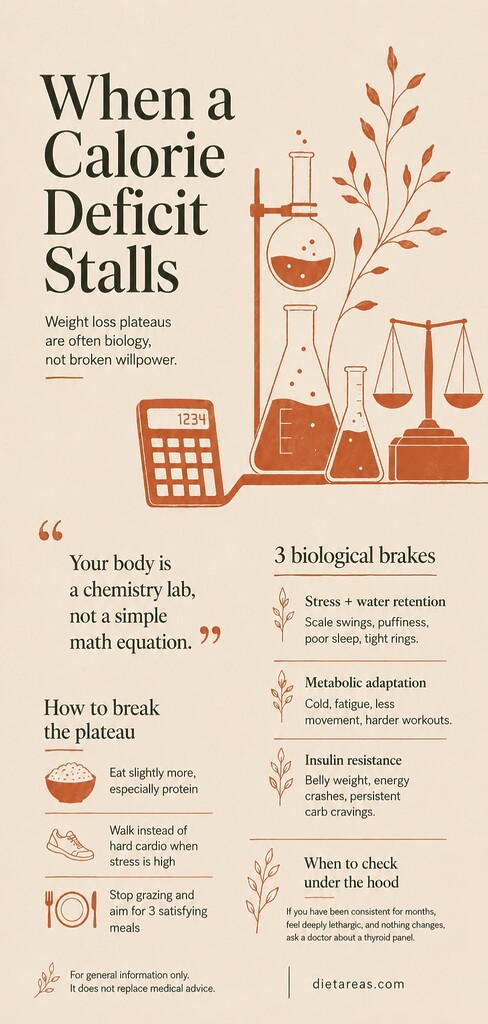
Your body is a highly sensitive chemistry lab, not a simple math equation.
When you reduce your food intake, your body does not immediately assume you want to look great in denim. It assumes a famine has arrived. Your metabolism actively adapts to keep you alive. This survival mechanism involves a cascade of hormonal shifts that change exactly how you burn the food you eat.
Three Factors Affecting Weight Loss Besides Calories
You might be wondering if you are just bad at counting. While hidden calories do happen, they do not explain every true weeks-long stall when you are genuinely trying. If the tracker is accurate, one of these biological handbrakes is likely pulled. Here is how to tell which one is holding you back.
1. Stress and Water Retention
Stress is completely invisible, but it carries physical weight. When you are overworked, under-rested, or running on an aggressive calorie deficit, your body floods with cortisol. High cortisol levels can affect water balance, which may leave you retaining more fluid than usual. You might actually be losing fat, but the extra water weight completely masks that loss on the scale.
How to tell if this is your roadblock: Your weight fluctuates wildly from day to day. Your rings feel tight. You feel puffy, your sleep is poor, and you are relying heavily on caffeine to get through the afternoon.
2. Metabolic Adaptation
Think of your metabolism like a smart thermostat in your house. If you open all the windows in winter, the heater does not just keep blasting. The system eventually lowers the baseline temperature to save energy. When you eat less for a prolonged period, your body begins to burn less. Your daily energy expenditure can drop lower than expected for your new body size.
How to tell if this is your roadblock: You feel constantly cold. Your workouts feel unusually exhausting. You find yourself sitting more often, unconsciously fidgeting less, and feeling a general sense of deep physical fatigue.
3. Insulin Resistance
Insulin is one of your key storage hormones. When insulin levels stay elevated, fat breakdown can slow, making it harder to access stored energy efficiently. This can happen more often when a diet leans heavily on refined, processed foods or frequent grazing throughout the day, even if your total calories are technically low.
How to tell if this is your roadblock: You carry weight primarily around your midsection. You experience sharp energy crashes a few hours after eating, and you battle intense, persistent cravings for sugar or carbohydrates.
When to Check Under the Hood
Sometimes the chemistry lab has a genuine malfunction. The thyroid gland regulates your baseline metabolic burn. If it is underactive, your daily calorie needs can drop below what any generic online calculator predicts. If you have been perfectly consistent for months, you feel deeply lethargic, and no lifestyle tweaks are moving the needle, ask a doctor for a comprehensive thyroid panel. Medical roadblocks require medical support.
How to Break a Weight Loss Plateau
When the scale stops moving, the natural instinct is to eat even less or run an extra three miles. That is the exact opposite of what a stressed metabolism needs. You have to signal to your body that the famine is over and target the specific roadblock holding you back.
Eat slightly more to ease adaptation. If you have been stuck in a deep deficit for months, add a modest amount of calories back into your daily meals, primarily from protein. This mild increase is not magic, but research on diet breaks suggests that controlled periods closer to maintenance can reduce some compensatory metabolic responses.
Swap high-intensity cardio for walking to drop water. Sprinting and heavy circuit training are fantastic, but they can spike cortisol. If water retention is masking your progress, trade the heavy cardio for a steady-state walk. It burns energy with a lighter stress response for many people.
Consolidate your meals to lower insulin. Stop grazing on small portions all day. For some people, one study on meal frequency suggests frequent small meals may blur hunger and fullness cues. Eat three satisfying, protein-heavy meals if that helps you feel steadier between feedings.
Frequently Asked Questions
Why am I not losing weight when my tracker says I am perfect?
Trackers measure the math, but they do not measure the hormones. If your calories are correct but the scale is stuck, your body is likely holding onto excess water due to diet-induced stress, or your metabolism has down-regulated to match your current intake. The math is easier to see when the chemistry is calmer.
How long does a normal plateau last?
A true weight loss plateau is a complete lack of change in both weight and body measurements for three to four consecutive weeks. If the scale has only been stuck for ten days, that is normal water fluctuation or digestion timing. Give any new routine a full month before deciding it has stopped working.
Is my metabolism permanently broken?
No. Your metabolism is doing exactly what it evolved to do. It is keeping you alive in a perceived energy crisis. By increasing your calories slightly, focusing on sleep, and prioritizing protein, your metabolic rate can adapt again.
Take a deep breath and put the food scale away for the weekend. Your body is incredibly smart, and once you start working with its chemistry instead of fighting its math, it will finally let go of what it no longer needs.


 This post may contain affiliate links.